In the 2000s, Iowa was seen as a safe haven for the LGBTQ+ community in the Midwest, but recent legislation looks to change that.
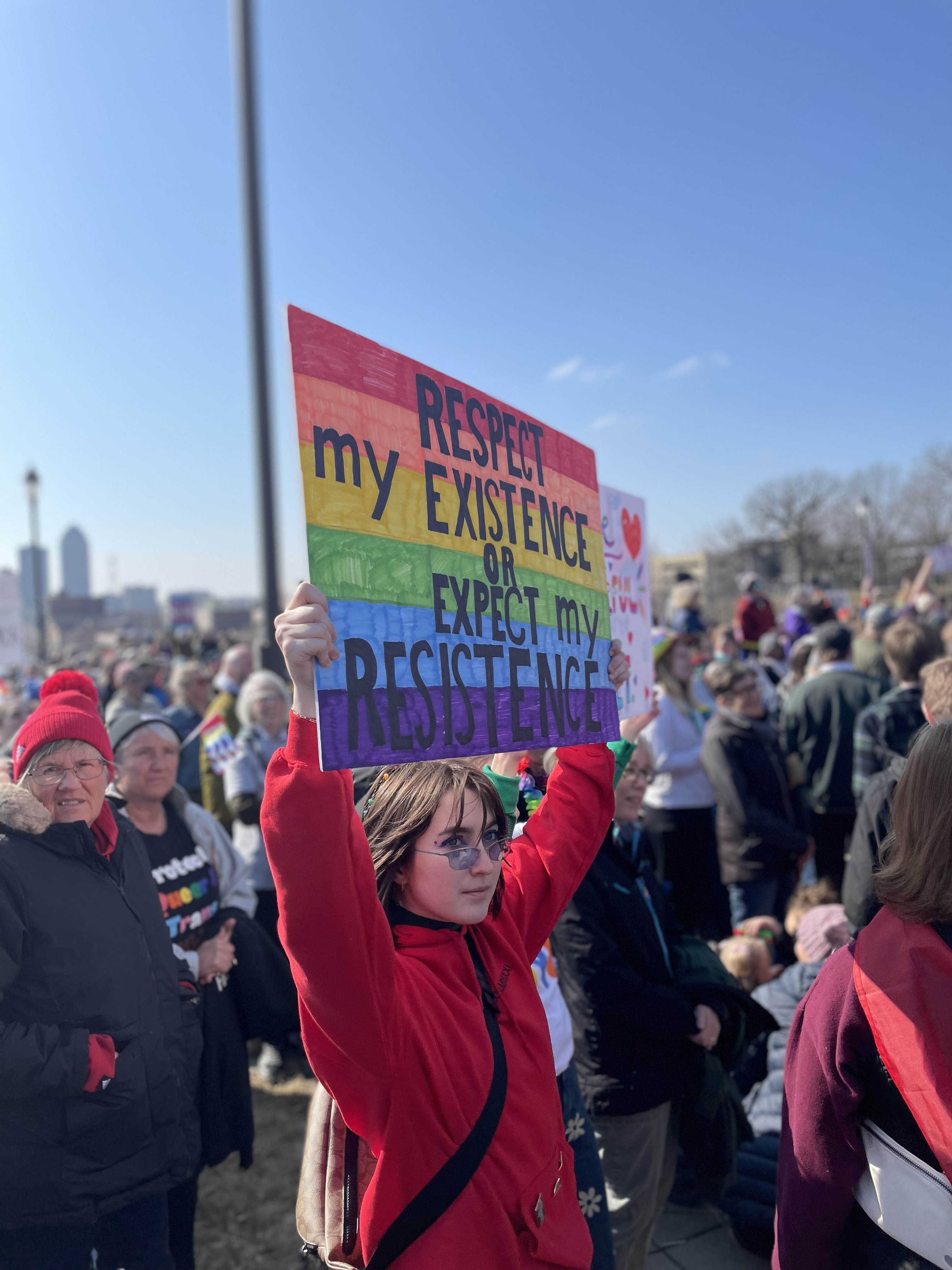
Over 30 bills targeting the LGBTQ+ community were introduced this year between both the Iowa Senate and House. All the bills were sponsored by members of the Republican Party, who control both chambers of the legislature as well as the governor’s office.
“All these bigoted politicians should not be dictating what we can and cannot read, what we can and cannot learn in school, the medical care we can and cannot receive, the people we can and cannot love and who can and cannot be,” said Rebecca, a high school student in Des Moines.
She said she is passionate about these issues because it is wrong to have to wake up everyday and wonder how the government is hurting either yourself or the ones you care about.
The American Civil Liberties Union has tracked over 400 anti-LGBTQ+ bills introduced in the 2023 legislative session across the United States. Only six states have not introduced legislation targeting LGBTQ+ Americans.
On Feb. 28, the Iowa House introduced Joint Resolution 8. Sponsored by eight Republicans, the bill sparked controversy as it would ban same-sex marriage statewide, a direct contradiction to federal law.
“Marriage, in accordance with the laws of nature and nature’s God, the state of Iowa recognizes the definition of marriage to be the solemnized union between one human biological male and one human biological female,” stated the bill.
Iowa Democrats were quick to criticize the measure as a step backward, especially since Iowa was the third state ever to legalize same-sex marriage in 2009 (following Massachusetts in 2003 and Conneticut in 2008).
“No, @IowaGOP, we will not be going back to the days when committed, loving same-sex couples didn’t have the same right to marriage equality as everyone else,” tweeted Democratic state Rep. Sami Scheetz. “This kind of disgusting hatred and backwards thinking has no place in Iowa.”
The marriage ban proposal did not make it out of committee. Of the 30-plus bills introduced, only 12 advanced through committees, and at the time of this article’s publication, only seven still remain in circulation.
“Governor Reynolds and the rest of the GOP claim they fight for freedom, but freedom really is the right to love who you wanna love, the right to identify how you identify,” said Democratic state Rep. Jennifer Konfrst. “We will bring love back to this.”
The seven bills that are currently in circulation or have already been passed by at least one of the chambers include:
- Senate File 538 – prohibits gender transition procedures for minors
- House File 616 – prohibits state colleges and universities from funding diversity, equity and inclusion programs
- Senate File 297 – allows health care providers to refuse care based on personal beliefs
- House File 367 – allows teachers to misgender students with no consequences
- House File 597 – bans materials in schools that mention sex
- House File 348 – prohibits any mention of gender identity or sexual orientation for grades K-6
- Senate File 335 – restricts students from using the bathroom associated with their gender identity in school
HF 348, originally designated as HF 8, was one of two proposed Iowa bills that restricted the teaching of gender identity in schools.
Republican state Sen. Jeff Taylor was the lead sponsor of SF 83, the senate’s equivalent of HF 348. The bill specifically aimed to increase the grades where gender identity education was banned from K-6 to K-8.
“The bill is a common sense proposal,” Taylor said. “Is the teaching of gender identity necessary for basic curriculum? No.”
He believes gender identity is not beneficial to teach to children and that the issue has been too politicized recently.
“I believe that this topic would not be taught with fact-based neutrality but rather serve as a type of indoctrination,” Taylor said.
Democratic state Sen. Herman Quirmbach served on the committee that oversaw SF 83. Qurimbach was the lone vote opposed to the bill.
“Every non-binary or transgender person I’ve talked to have all said the same thing: They knew they were different from an early age,” Quirmbach said.
This statement was further supported by Keenan Crow, the policy director at an LGBTQ+ activist group called One Iowa, who said the typical age for transgender youth to come out is around nine years old.
“Contrary to the belief of the folks proposing this, kids have a very well-developed sense of their gender identity by the time they’re going to school,” Crow said.
Quirmbach also believes this bill violates Article 1, Section 6 of the Iowa Constitution which states that all laws must be applied uniformly. He points to Iowa Code 279.5, which requires all Iowa school districts to teach about human growth and development starting in kindergarten.
“What this bill is trying to do is tell the public schools that they can’t meet the human growth and development needs of those minority populations,” Quirmbach said. “This bill denies a certain fraction of the population equal education about their own human growth and development.”

A big concern from the general public surrounding a lot of these bills is a potential increase in bullying targeted toward LGBTQ+ youth, though Republicans don’t believe that will be an issue.
“No child in Iowa deserves to be treated with anything other than respect,” Taylor said. “However, this does not mean that adults must affirm everything that a child believes.”
In response to all this legislation, two protests were held at the state Capitol. The first was held on the front lawn on March 5, and the other was a sit-in in the rotunda on March 8. Speakers included Jennifer Harvey, associate provost of equity and inclusion at Drake University, Konfrst, Crow and other members of the community.
Crow said they weren’t expecting the amount of people that turned out for the March 5 protest, but it was a pleasant surprise to see hundreds of people from all over Iowa come together.
“I was exhausted, but after seeing all these people, I am rejuvenated,” Crow said.
People of all ages attended the protest, including Rebecca. During Crow’s speech, they thanked everyone involved and those who showed up for being the reason why they have hope in Iowa.
“Because of you all, the ban on marriage equality is done. There is still hope we can all live in a more welcoming Iowa,” Crow said in their address. “However, I am still disgusted, and I am still pissed. There is still way more work to be done.”
LGBTQ+ activist groups, including One Iowa, will continue to hold rallies, work with constituents and fight back against the bills.
“These bills send a message that trans and queer folks are not allowed in Iowa, which we all know is not true. So, I ask all these people who are trying to get rid of us, why are you afraid of our queerness?” Rebecca said. “We are here, we are queer, and we will not disappear. This is our state.”
Click here to read PDF of original article.
Leave a Reply